

Parabens: Friend or Foe?
Posted by LT on Sep 18th 2026
Parabens: Friend or Foe?
If you've shopped for shampoo, lotion, or sunscreen in the past decade, you've probably seen a "paraben-free" label — usually presented as a selling point, as if avoiding parabens is an obvious win. But the science behind that marketing is a lot less dramatic than the labels suggest. Parabens are one of the most extensively studied classes of preservatives in the cosmetics and personal care industry, and the regulatory and scientific consensus doesn't match the "toxic chemical" reputation they've picked up. Here's an honest look at where the concerns came from, what the evidence actually shows, and why using parabens at effective levels is part of what keeps products safe in the first place.
What Parabens Actually Do
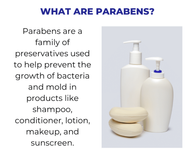
Parabens — methylparaben, ethylparaben, propylparaben, and butylparaben are the most common — are preservatives used to stop bacteria, yeast, and mold from growing in cosmetics, pharmaceuticals, and some foods. The FDA notes they're used specifically because they prevent the growth of potentially harmful microorganisms in products that would otherwise spoil quickly, especially anything water-based like lotions, conditioners, and creams.
They've been doing this job for a long time — parabens have been used as cosmetic preservatives for more than 70 years, and they remain one of the best-studied preservative families in the industry. That's not a small thing in a category where "natural" or "clean" alternatives often come with their own trade-offs, which we'll get to.
Where Concerns Came From
The modern paraben scare traces back to a single 2004 study. Dr. Philippa Darbre and colleagues at the University of Reading published a paper reporting that intact parabens — mostly methylparaben — were detected in 20 human breast tumor samples, and Darbre suggested it was "especially prudent to consider whether parabens should continue to be used" in underarm cosmetics, given that parabens can mimic the hormone estrogen, which is associated with breast tumor growth.
That study got a lot of media attention, and understandably so — it's the kind of finding that sounds alarming in a headline. But it's worth understanding what the study actually showed, and just as importantly, what it didn't.
- The study had no control group. The single most-cited criticism of the Darbre paper is that it never measured paraben levels in normal, non-cancerous breast tissue for comparison, so there was no way to tell whether the levels found in tumor tissue were unusual at all, or just reflected ordinary paraben exposure that shows up in everyone.
- The lab's own blank controls were contaminated with parabens — in some cases at higher concentrations than what was found in the tumor tissue itself, which raises real questions about whether the results reflect actual accumulation in tissue or contamination during handling.
- Darbre herself said the study didn't prove causation. In the peer-reviewed paper, she and her co-authors were explicit that finding parabens in tumor tissue does not mean parabens caused the tumors, and that more research was needed before drawing any conclusions about a link to breast cancer. Two decades later, that's basically where the science still stands — Darbre herself has noted there have really only been two studies ever measuring parabens directly in breast tissue, hers from 2004 and one other from 2012, and the overwhelming scientific consensus remains that parabens are unconnected to breast cancer incidence.
Sourcing parabens or a paraben-preserved formulation?
Browse Level 7 Chemical's current paraben and preservative inventory.
Other Understandable Concerns People Raise
Breast cancer risk isn't the only worry that comes up around parabens. A few others worth addressing directly:
Endocrine disruption / estrogenic activity. This is the mechanism behind the breast cancer concern, so it's worth its own look. Yes, lab studies have shown parabens can weakly bind to estrogen receptors — this was first shown in a 1998 study that tested parabens in yeast cells and live rats. But "weakly" is the operative word. The FDA states plainly that studies have shown parabens have significantly less estrogenic activity than the body's own naturally occurring estrogen, and that parabens have not been shown to be harmful as used in cosmetics, where they're present only in very small amounts. Reviews of the endocrine-disruption literature have similarly concluded that real-world exposure from cosmetics is far too low, by orders of magnitude, to translate into a proven health effect, even though the biological activity is measurable in a lab setting.
Skin irritation and allergic reactions. This is a legitimate consideration for a small number of people — but the direction of the finding tends to surprise people. In 2019, the American Contact Dermatitis Society named parabens their "nonallergen of the year," specifically to draw attention to how low their allergic reaction rate is, despite the high public interest in avoiding them. Patch testing studies found positive reaction rates of well under 1% (around 0.6–0.8%), and a dermatologist involved in the designation called parabens "perhaps the safest" preservative from a skin-reaction standpoint. That matters for formulators, because the preservatives people reach for as paraben substitutes — including some formaldehyde-releasing preservatives and certain isothiazolinones — carry meaningfully higher rates of allergic contact dermatitis.
Regulatory bans and restrictions. It's true that regulation has tightened, and this is probably the most legitimate source of ongoing concern. The EU banned five longer-chain parabens (isopropyl, isobutyl, phenyl, benzyl, and pentyl parabens) outright in 2014 — not because of proven harm, but because of a lack of safety data on them specifically — and restricts propyl- and butylparaben to a combined 0.14% concentration, with methyl- and ethylparaben still permitted up to 0.4% each or 0.8% combined. In the U.S., the picture is shifting fast at the state level: as of early 2026, at least twenty states have passed laws restricting cosmetic chemicals, with parabens among the most frequently targeted ingredients, and California's Toxic-Free Cosmetics Act along with similar Washington and Maryland laws now ban intentionally added parabens in cosmetics sold in those states. It's worth noting the federal FDA has not followed suit — parabens are not a current FDA rulemaking priority, and the agency continues to state that parabens are considered safe as used in cosmetics.
The pattern across all of this: regulators are being cautious about the parabens with the least data (the longer-chain, less-studied ones), while continuing to permit the two most common and best-studied parabens — methyl and ethyl — at established safe levels.
Why Concentration Level Matters Just as Much as the Ingredient
This is the part that gets lost in most "paraben-free" marketing: the entire safety case for parabens depends on using them at the right concentration — not too little, and not more than necessary either.
Too little, and you haven't solved the actual problem preservatives exist to solve. Cosmetic products — especially anything water-based, like lotions, creams, and liquid soaps — are genuinely vulnerable to microbial contamination during manufacturing, shipping, and repeated consumer use. Studies testing personal care products on the market have found that a majority of unpreserved or under-preserved samples showed microbial contamination, while properly preserved samples passed standard efficacy testing. An under-preserved product isn't a "cleaner" product — it's a product that can grow bacteria, yeast, or mold, which is a direct consumer safety issue, not a hypothetical one.
Parabens are effective specifically because they work as a broad-spectrum preservative across a wide pH range, and different chain lengths cover different threats: shorter-chain parabens like methyl- and ethylparaben are most effective against Gram-positive bacteria, while longer-chain parabens like propyl- and butylparaben are better at targeting yeasts and molds. That's why formulators frequently use them in combination — a single paraben alone typically won't cover the full spectrum of microbial threats a product needs to be protected against.
At the same time, "more is better" isn't the right instinct either. Excessive preservative levels — parabens or otherwise — can themselves increase the risk of skin irritation and adverse reactions. This is exactly why regulatory bodies like the EU's Scientific Committee on Consumer Safety set maximum-use concentrations rather than simply banning or unrestricting an ingredient: the goal is to land in the range that's high enough to actually preserve the product, and low enough to stay well under any level associated with harm. Industry guidance for formulators reflects this same balance, typically recommending parabens in the 0.8%–1.0% total concentration range for effective preservation — notably below the regulatory ceiling, which itself already includes a wide safety margin.
This is really the core of the "friend or foe" question. Used at trace, engineered-for-purpose concentrations, parabens do their job — protecting the product and the consumer — with a well-documented safety and low-allergenicity track record. It's a formulation and dosing question, not a black-and-white "this molecule is bad" question.
The Bottom Line
The honest answer to "parabens: friend or foe?" is that they're neither a villain nor a magic ingredient — they're a well-understood, thoroughly studied preservative that does exactly what it's supposed to do when used at the concentrations regulators and formulators have established as both effective and safe. The 2004 study that sparked the modern paraben panic had real methodological problems and never established that parabens cause harm. Two decades of follow-up research, FDA review, and international regulatory scrutiny haven't changed that conclusion for the most common parabens. Meanwhile, the alternative isn't "no preservative" — it's a different preservative, often with its own trade-offs in cost, stability, or allergenicity.
If you're formulating or sourcing for a product that needs a reliable, broad-spectrum, well-characterized preservative, parabens remain one of the most studied and predictable options available — provided they're used at the levels the data actually supports.
Sources: U.S. Food and Drug Administration (FDA.gov); Darbre et al., "Concentrations of Parabens in Human Breast Tumours," Journal of Applied Toxicology (2004); Harvey & Everett, Journal of Applied Toxicology (2004); Golden, Gandy & Vollmer, "A review of the endocrine activity of parabens," Critical Reviews in Toxicology (2005); American Contact Dermatitis Society / Cutis (2019); Environmental Working Group.